Do you also want access to our video library?

  • 2500 videos
  • No binding period
  • Free trial

Welcome to our blog

Yoga, training and health inspiration for you

blog post thumbnail

What is emotional regulation and how can we practice it?

13 January 2026 | Av

Emotional regulation is often misunderstood as a way to control or suppress what we feel. Here, Eleonora Ramsby Herrera shares her perspective on emotions as meaningful responses that help us orient ourselves in the world and serve as a compass for self-understanding, relationship and conscious choice – and how practices like meditation and breath can support this process.

Emotions can help us orient to the world

The way I understand emotional regulation is closely aligned with an existential view, where emotions serve as an orientation to where we stand in the world. Emotions can tell us something about what is happening to us and how it affects us in a particular moment. In this sense, emotions are not merely internal states to be managed but meaningful responses to our lived situation.
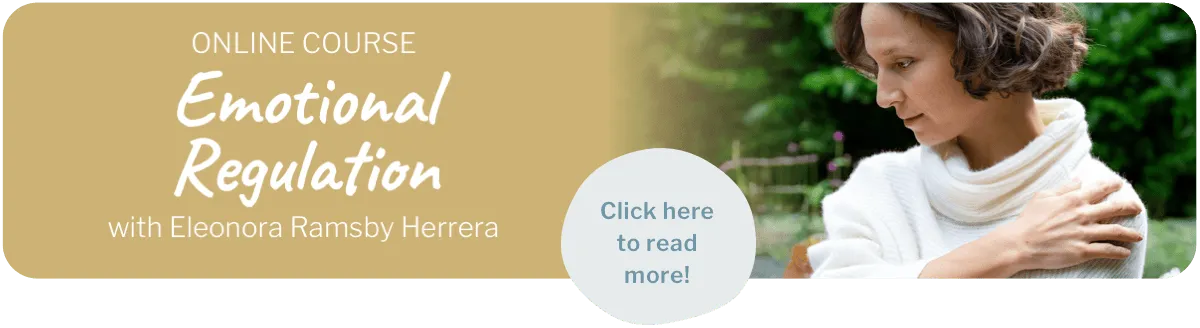
Emotional regulation is sometimes misunderstood as a means of controlling our emotions by trying to remain calm and detached amid chaos. This can border on spiritual bypassing, a term introduced by late Buddhist and psychologist John Welwood to describe how a spiritual practice can become a way to avoid, rather than engage with, the realities of our life. Consequently, it can create distance from experience, severing our connection with the world and our relationships within it. We are not separate individuals moving through the world unaffected by what happens around us; rather, we are always in relationship with it. We cannot touch something without being touched ourselves.

Emotional regulation as awareness rather than control

Instead, emotional regulation can be understood as the capacity to be aware of our emotions and to acknowledge that we never encounter the world in a neutral way. Our interactions are always coloured by our assumptions, histories, and perspectives. While we cannot remove this lens, we can become more attuned to how strongly it shapes us and how we allow it to influence our way of being in the world.

We can either be reactive to our emotions, controlled or overwhelmed by them, or suppress them because we do not like how they feel. Alternatively, as existential philosopher and psychotherapist Emmy van Deurzen suggests, we can learn to relate to emotions as a compass for orienting our lives and to approach them as moments of learning through self-enquiry. This can be done by reflecting on questions such as: What happened for me to feel this way? What did I or didn't do in that moment? How can I take charge and control the situation as it is now? Can I do something different about it that will shift how I am in the world and with people, in such a way that I am happy to go by my emotions rather than being run over by them?

Meditation and breath as tools for emotional regulation

A central aspect of this work is learning how to be with our emotions as they arise in present-moment experience. Meditation can be a supportive practice here, as it allows us to feel emotions fully and directly within a space of stillness and contemplative compassion. Here too, the breath can be our companion, helping us remain grounded and steady amidst the inner turbulence that may arise.

A full and meaningful life is not one that avoids difficult emotions, but one that embraces the full range – from joy and laughter to rage and sorrow. This is part of what it means to be human. From this perspective, learning to live with our emotions and to use them as guidance for conscious choice allows us to inhabit our lives with greater clarity, depth and wakefulness.
Online Course: Emotional Regulation with Eleonora Ramsby Herrera

Interested in exploring practices to navigate your emotions? In the online course Emotional Regulation, Eleonora Ramsby Herrera guides you through simple ways to regulate your nervous system and support your emotional wellbeing using meditation and pranayama.

Read more here!

Practice Online – Meditation & Breathwork

Yogobe Video: 6a8w4e Yogobe Video: 27ucw4 Yogobe Video: zt9x23 Yogobe Video: 6rs2

To watch a full video, you need to be logged in as a paying Yogobe member. Haven’t tried Yogobe before? Try it free for 14 days – get started here!

Further reading

Open post
blog post thumbnail

Yoga from a scientific perspective – for a sustainable body, mind, and community

06 September 2022 | Av

How can yoga help us to find our way towards restful states and to move our bodies? I will tell you more about yoga’s benefits and what the research says.

Pockets of time where we can catch our breath

Whatever happened to margins, air in the schedule, and our perspectives on tempo? In our modern society, in the chase for efficiency and performance, we quite often find ourselves with packed schedules ready to burst. We seem to somehow have removed the margins, those pockets of time where we can catch our breath and relax. Not only have we built away moments for doing ‘nothing’, moments of physical movement also seem to have gotten lost.

The question I will address here is, how can yoga help us to find our way towards restful states and to move our bodies? I will tell you more about yoga’s benefits and what the research says.

Yoga as a support for physical and mental health (challenges)

Yoga is unique. It is unique in the way that it contains both movement and rest, two things that many of us lack today. This is true from us as individuals, bur also for our society. We have built away getting between places through movement, we have built away the margins in our schedules that would have given us recovery. To mention a few.

Although our health has generally improved over the past 100 years, with increased life expectancy and fewer deaths and infectious diseases, we face other problems. Challenges we face are all the years that we live but with reduced health and function. Today, it is (too) common to be struggling with mental illness such as depression, stress and fatigue, pain e.g. It is easy to think that it does not concern you or me, but most likely you will have already experienced something of the mentioned yourself, or have had someone close to you who has. When challenges like this hit you or your loved ones, it can be very helpful to have wellness and coping strategies at hand.

Fortunately, I think we as communities are starting to realize that many are facing these challenges, and we now know that we can do something about it. But then, what can we do? Yoga might be the answer.

What is yoga?

In order to be able to answer what yoga ’works for’, let's for a moment concretize what we mean by yoga. Even though yoga can take many shapes and forms, within the (medical) scientific landscape, yoga can be described, mainly, as having the following four components:

  • Low-intensity form of physical activity
  • Relaxation
  • Breath
  • Meditation

When researchers investigate the reason why we engage in yoga, it is mainly two reasons that come up:

  • For wellbeing and to prevent ill-health.
  • To take care of pre-existing health problems such as depression, exhaustion, pain, and anxiety.

Reserach shows effects from breathing exercises and meditation

  • When you have two minutes to spare:
    Some researchers investigated the effect of slow breathing on a group of yoga beginners. By breathing slowly for two minutes, both blood pressure and the experience of anxiety were lowered. The likely mechanism behind the effect is increased activation of the calming part of the nervous system. Exciting news, as a large percentage of us walk around with high blood pressure, much due to our lifestyles with a lack of physical activity and stress management.
  • When you want to sleep better:
    The hours of sleep in the day are your most important restorer. The hormone melatonin is an important regulator in the body to stimulate sleep. Some researchers, therefore, wanted to investigate melatonin levels in connection with meditation. A small group of experienced meditators meditated with different techniques, one group meditated for 30 minutes with one technique and another for 60 minutes with another. The meditation took place at midnight just before melatonin levels are at their peak. Blood samples were taken once an hour to measure levels, between 10 pm and 2 am. Another night the same things were measured but without the meditation to check for any differences in levels. Both groups got increased levels of melatonin the night they meditated. The researchers, therefore, theorized about how this effect can positively affect sleep. Most likely, meditation can be practiced at any time of the day, depending on the effect you want to achieve. So you don't necessarily have to meditate in the morning, or at midnight.

The effects of yoga compared to other physical activity

The calmer components of yoga can thus have a positive effect on things that have a strong connection to our health. However, most research that has been done on yoga involves yoga's physical activity components of some kind.

So how does yoga compare to other physical activity? This is something that is currently being researched intensively. As an example, one of the largest studies conducted on mild and moderate depression was conducted in Sweden, where several hundred participants took part. Three training groups (yoga, and two other cardio training groups) performed their training three times a week for 60 minutes, for a total of 12 weeks. That study showed that yoga produced the same effect as moderate- and high-intensity cardio exercise on lowering the level of depression, in particular compared to usual treatment.

In summary, yoga reminds us to move the body we were given and it can make us aware of how it feels at the moment. Yoga also reminds us to slow down, and pace the outer tempo with our inner tempo.

Yoga in the future

Change is inevitable, but which direction change takes can often be influenced by the actions we and our communities choose to take.

I believe that we have to start to rethink how we construct our schedules in the present moment, and for the future. In politics, at workplaces, at schools, in our residential areas, and at home. Building sustainable practices and communities means bringing back the margins and pockets of space in our schedules to do nothing, as well as for opportunities to move and relax. To create opportunities for yoga. As individuals, we must show that we want change through the choices we make on a daily basis. We must be the role models we want others to be for us. For ourselves, but above all, for others. It is something we can do together. Every small change matter, because it accumulates into something bigger. Our vision about the future begins right now, in this exact moment, through action. I guess next question is: what will your next step be?

Foto: Malin Wittig, copywright Bonnier Fakta (top image)

Playlists and more to read about science and yoga

Videos to get you started

Yogobe Video: 4gu3 Yogobe Video: ax64 Yogobe Video: 9uh4 Yogobe Video: d72r Yogobe Video: pf54 Yogobe Video: s6k9

To see a whole video you need to be logged in to Yogobe, as well as a paying member. First time here? Try our subscription service – free of charge for 14 days! 

Refereces:

Open post
blog post thumbnail

15 minutes of meditation – like a vacation day

08 July 2021 | Av

Is there a trick that is as effective for health as vacationing? The psychologists in an American-Dutch research team believe that meditation can be that.

Meditation provides similar health effects as a vacation day

A research team at the University of Groeningen in the Netherlands has investigated what health effects meditation can have in everyday life - compared to having vacation. The study showed great similarities!

The participants in the study were about 40 university students, all of whom were beginners in meditation. For eight weeks, participants did a meditation every two weeks, and no meditation every other week. The meditation was a 15-minute pre-recorded guided meditation  and the participants had to complete an evaluation every night.

Participants reported fewer negative emotions and greater well-being during the days they meditated. During these days, they also found it easier to observe their sensory experiences, describe thoughts and feelings, and resist emotional impulses. All of these qualities describe mindfulness well – being in a present, non-judgmental state.

During the meditation days, the participants agreed more with statements such as "I was more aware of things like the ticking of a clock, birdsong and passing vehicles" and "I was aware of my feelings without getting lost in them". This was also true for the people who were studied during their vacation.

Meditate and gain more stability in your emotions

One of the researchers behind the study, Christopher May, told the psychology site PsyPost that only 15 minutes of meditation is associated with similar effects as a full vacation day in terms of mindfulness aspects.

– Both the meditators and the holidaymakers reported increased attention to their surroundings and increased stability in their emotional experiences.

But how were the effects on well-being in general? The holidaymakers had more far-reaching positive effects on the overall well-being. But the researchers says that their results only show the effect on beginners who have meditated for shorter periods – regular meditation has even deeper effects and is also built on over time.

– We jokingly write in our article that if you are short on time, you can sit on a meditation pillow – if you have plenty of time, you can sit on a beach chair, says Christopher May.

Who says you cannot do both this summer? Meditate and go on vacation that is. Take a break, focus on your breathing and check in for a while.

Source: Chef.se

Read more about meditation, mindfulness & research

Videos with meditation online

Yogobe Video: g5w6 Yogobe Video: k5t3 Yogobe Video: h85u Yogobe Video: 3u4g

To watch a full video you need to be logged in as a paying Yogobe member. Haven't tried Yogobe before? Try it for free during 14 days – get started here!

Open post
blog post thumbnail

What is metta meditation?

14 April 2021 | Av
Yogobe

Metta meditation is a Buddhist meditation that focuses on loving kindness. You direct the feeling first to yourself, then to someone you hold close, and to all living beings. Here you will learn more about metta bhavana meditation that can help you to open your heart.

Metta bhavana – meditation for loving kindness

In Buddhism, there is no word that means the same as our Western "meditation". Instead, they usually use the word bhavana, which means "cultivation" or "cultivation of". For example, if you focus your attention on the breath, it is called anapanasati bhavana, ie the cultivation of attention (sati) on the inhalation and exhalation (ana-pana).

Bhavana shows that meditation is something you actively do, not something that just happens by itself. To meditate, some effort is needed – a balance between effort and receptivity, to let go. In metta bhavana, it is metta (loving kindness) that you grow, awaken or produce. 

Metta is a deep desire that things will go well for both yourself and others. It is free and does not need anything in return. This desire comes from an open heart, and is based on the fact that we deeply identify ourselves with other people and everything that lives and breathes.

Metta meditation – an excercise

  • Sit comfortably and relaxed.
  • Take two or three deep breaths with long exhalation.
  • Become aware of how you feel in the body, how you feel right now.
  • Give yourself permission to experience whatever you feel.
  • For a few minutes, feel or imagine how the breath moves through the center of your chest – in the area around the heart.
  • Peacefully begin to mentally repeat, slowly and steadily, the following or similar phrases:

May I be happy.
May I live in peace and harmony.
May I be safe and secure.
May I have patience and courage.

Start with yourself, then expand to someone close and then to all beings, "May you be ...". Try to keep the phrases in your heart just as you would hold something fragile and precious in your hand.

When you say the phrases, distracting thoughts may emerge. It starts to itch on your forehead, your knee hurts or you start thinking about the job interview you have tomorrow. When the distraction comes, try to get back to the phrase again and again.

The liberation of the heart – metta is also being kind to oneself

Of course we are not always so present or open-hearted, and it takes time and patience to cultivate metta. But if we are in contact with ourselves and are aware, we will naturally wish that things will go well for others. Metta can then arise only by thinking about or becoming aware of another.

Metta meditation can be the heart's path to liberation – having a friendly attitude towards oneself is also part of metta.

Källa: Viryabodhi, Tricycle

Read more about meditation, mindfulness and wisdom

Videos with meditation and loving kindness

Yogobe Video: x83k Yogobe Video: z5a3

To watch a full video you need to be logged in as a paying Yogobe member. Haven't tried Yogobe before? Try it for free during 14 days – get started here!

Open post
blog post thumbnail

Can mindfulness help the growing brain in children and adolescents?

24 March 2021 | Av
Yogobe

Mindfulness can help you focus, feel happier and reduce your anxiety. But what does research say about mindfulness for children? And what happens when schools have mindfulness on the schedule? Read more about how mindfulness can help children and young people – while their brains grow.

Mindfulness for children can lay the foundation for good habits

Mindfulness is a meditation technique that is about learning conscious presence, which increases the feeling of calm in both body and mind. Mindfulness is used today in care and psychotherapy to treat various stress symptoms and states of depression, anxiety and worry. Researchers have also shown that the practice of mindfulness and meditation can improve the immune system, lower blood pressure and even change the structure and function of the brain.

Developmental neurologist Hilary A. Marusak of Wayne State University, USA, has been interested in how mindfulness affects the brains of children and adolescents while it is still developing.

– I believe that mindfulness and meditation may be especially beneficial for children and teens because these skills may strengthen brain circuits that control the ability to focus and concentrate and to regulate emotions, which are maturing during this time. Establishing these habits early in life may also set the stage for good habits later in life, says Hilary A. Marusak.

How does mindfulness work?

When you practice mindfulness, you use all five senses: touch, hearing, sight, smell and taste, to focus on the present moment. One of the most common ways to practice mindfulness is to focus on your own breath.

The tendency for the mind to wander, or lose focus on the present, seems to be a standard state of brain function – and can actually be beneficial. The wandering thoughts can, among other things, trigger creativity. But the wandering mind can also go wrong and lead to excessive worry, focus on negative things or dwelling on the past. Research also shows that we are less happy when thoughts and minds wander than we are when we pay attention to the present.

Mindfulness can also help reduce distraction. Being distracted can disrupt children's ability to handle schoolwork, manage relationships with friends or family, or regulate emotions, which is a problem in today's fast-paced world of distractions everywhere.

Effects of mindfulness on the growing brain

Hilary A. Marusak's study examined how mindfulness affects brain connectivity in children and adolescents. The study scanned the brains of 42 children and adolescents between the ages of 7 and 17, using fMRI (Functional Magnetic Resonance Imaging). Participants' degree of "natural awareness", mindfulness as a trait was also measured.

It turns out that children who are more attentive in the present can act more consciously. They also find it easier to observe and accept their inner experiences without judging them. Adolescents with greater attendance reported lower anxiety levels and their brains switched more often between different connectivity states during the scan.

Greater flexibility in the brain can help explain some of the perceived positive effects of mindfulness training in children and adolescents.

Mindfulness in school

Several schools today use mindfulness as a way to help students in school environment and in everyday life. Swedish television SVT reported, for example, about the International School ISGR in Gothenburg:

– We have noticed fantastic results with calmer and more focused students which has made both mine and their working environment much better, says teacher Camilla Martinsson.

At ISGR, three classes in grade four have done mindfulness exercises for ten minutes a day for just over a year. In 2020, mindfulness was introduced on the schedule in 20 classes at the school.

– There are far fewer social conflicts now. The children can follow the reasoning and join in in a different way, says Camilla Martinsson. Many of the students also say that they sleep better.

Read more about mindfulness in swedish!

Source: Oregon live, SVT, Göteborgs stad

Read more about yoga and mindfulness 

Videos online –  mindfulness and breathing

Yogobe Video: 7z3r Yogobe Video: x83k Yogobe Video: 4x2r Yogobe Video: 4s5p

To watch a full video you need to be logged in as a paying Yogobe member. Haven't tried Yogobe before? Try it for free during 14 days – get started here!

Open post
blog post thumbnail

Experience gong and the healing qualities of sound – interview with Mateusz Krawiec

04 November 2020 | Av
Sara Jakobsson

Sound healing helped him find his inner strength when struggling with addiction, today he gives gong concerts and sound healing sessions on a weekly basis. In this interview with yoga teacher and gong player Mateusz Krawiec you can read more about his work and learn how sound healing changed his life. 

Sound healing offers a free ride to meditation

The first time I participated in one of Mateusz Krawiec's gong concerts was a couple of years ago and I was struck by the calm and presence I experienced only by lying down and tuning in to the sounds from the gong and the singing bowls. Recently, I took a sound session class at Urban Om and had a little chat with Matuesz about his gong concerts and the phenomenon of sound healing.

How did you get into gong and sound healing?
– In my mid twenties, almost twelve years ago, I was addicted to alcohol and also struggled with drugs. My friend had a big awakening through theta healing and bought himself gongs and singing bowls, and played them for me once a week. After each session, I found myself in an amazing space, reconnected to my inner resources. I found the motivation to deal with my addiction, and from that on, sound healing became a part of my life.

When did you start giving concerts?
– It just happened to me. One day, I was carrying all my instruments and my neighbour asked me: Oh, I didn't know you were also a musician! (because he's a musician) and I was about to say no. But then I looked at all my instruments and I realized that this weekend, I have five sound journeys and I was like.. Am I a musician? Wow. So it just happened, it just sprouted, it wasn't my plan. I woke up one day and realized, this is what I'm doing. 

Cool! It seems like more and more people are getting curious about sound healing?
– Yeah, it's growing and I'm glad to see more people playing gong. I want to see gong in hospitals, prisons and schools.

What is it about sound that makes it so calming and healing?
– There are so many aspects of that. Scientifically there are theories about the physical structures of the blood cells, change in brain waves, electrical impulses from neurons, different markers of wellbeing like heart rate variability and so on. And it's all great to be able to measure such things, I honor that, but in the end, what we need to remember is that something holistic, something that works so holistically, is very difficult to capture and to grasp as a whole definition. One of the greatest confirmations for me is what I see people experience and what they are telling me about their experience, the testimonials of the participants. Like qualities of how their life improved, physical and spiritual healing processes, I even heard some interesting testimonials from cancer patients.

Do you have any special memory or experience with sound healing that you want to share?
– I remember waking up after a white sound session, and for like 30 seconds, I didn't understand that I was born into a human body on planet Earth. I was just traveling through space, and the feelings I had were like explosions of light in darkness, when traveling at light speed through the galaxy. And yeah, it took me a while to realize that I was born in a human body and that I was at Reimersholme in Stockholm. It was amazing. People use drugs, breathing techniques and other methods to experience such a deep state, but I think sound is the most accessible and safe way.

Is sound healing for everyone?
– It's for every human being. For most people it's relaxing, it’s a free ride to meditation. But in some cases there's fear, tension or trauma involved, and then I would recommend not so much of a public space, rather a private session. For the therapeutic parts of sound healing it's important for the facilitator to create a safe space for the participants.

– The sound goes where it's needed so you just have to trust the process, you don't need some special skills. The Art of Union, as I call my work with sound and therapy, emphasises on the therapeutic part of sound healing, but it’s also a spiritual practice and a form of art, so you can enjoy gong from many different approaches.

Further reading about meditation, breathing and chanting

Yoga online - videos with sound and singing

Yogobe Video: p75k Yogobe Video: r6f9 Yogobe Video: f5k4 Yogobe Video: 8a5b

To see a whole video you need to be logged in as a paying Yogobe member. Haven't tried Yogobe before? Try it for free during 14 days – click here to get started right away!

About Mateusz Krawiec

Mateusz is a yoga teacher, gong player and movement entusiast from Wroclaw, Poland, now living in Sweden where he gives concerts, classes, workshops and teacher trainings. With the intention to keep his perspectives as wide as possible, he has studied many different traditions and disciplins of yoga, movement and sound healing. If you are interested in attending one of Matusz's gong concerts, book a private session or learn how to play gong you can visit his website here or check out Mateusz Facebook-page for upcoming events.

Open post
blog post thumbnail

Meditation as a sacred practice

24 June 2020 | Av
Yogobe

For yoga and meditation teacher Eleonora Ramsby Herrera, meditation is a sacred practice. It's a process without a means to an end. Meditation is there to remind you that you are perfect as you are. In this interview she shares her thoughts on meditation and how it can support you in life.

You are human and perfect

Eleonora Ramsby Herrera has taught yoga since 2008. She is developing and running teacher trainings in London, Stockholm and Lisbon and has also worked with trauma-adapted yoga. Eleonoras’ yoga classes are multi-dimensional and contemporary in nature. Movement, breath, touch, sound and poetry weaved together into a well-rounded embodied experience. We asked her some questions on meditation – and she gives her best advice on how to start meditating. Come join!

1. How did you start meditating?
I was introduced to meditation as a child through my parents. My mom works in holistic therapy and one of the things she does is to teach meditation. I would participate in her meditation retreats and she would also introduce me to CD´s with guided meditations that I listened to before going to sleep as a child.

For me, meditation is a sacred practice and there are many forms of sacred practices, religion being one of them. I attended both Catholic kindergarten and Sunday school growing up. Now, I was not their ideal Catholic student, far from it, nor do I consider myself religious and I don’t think you have to be to do any form of meditation, but I do consider myself to have a spiritual practice. Thanks to the Catholic practices, rituals became an important part of growing up. My father and I would pray and contemplate on the divine as part of our everyday life, and that too is a form of meditation to me. So, these early childhood years shaped my personal and professional practice that I have today.

Later on, as I had just begun teaching yoga in 2008, I came across Michael Stone’s book “The Inner Tradition of Yoga” which left a permanent imprint on my consciousness. I keep returning to his book, and I also include it as mandatory reading in all my teacher training courses. I was lucky to formally train for Michael in 2016 at Yogacampus in London, and that further contributed to the depth and breadth of what my practice consists of today.

2. How has meditation affected your life?
Meditation humbles me and helps me remember that I am human with all the nuances that entail. In moments when I feel disconnected, the practice is there to bring me home to myself. It reminds me that everything is a process and it’s important to let those processes take the time they need to take.

3. How can meditation be supportive when life feels hard? 
Meditation is not like a magic wand that take all our troubles away. However, it can help us broaden our perspectives and thereby change how we approach life’s challenges. Meditation can give us the space to sit with our discomfort and to stop fighting or fixing it, and instead, we can gently face our present moment with acceptance. Like a good friend, meditation provides us with a space to be listened to. As we sit with whatever emotional turmoil that we may be faced with in that moment, we give ourselves permission to be as we are. This can in turn help to ease any pressure we might put on ourselves and thereby cultivate more compassion and acceptance into our lives.

4. Your best advice on how to start meditating? 
Find a meditation method that works for you, whether it is guided or not. Feel free to try out a few practices and teachers before finding a method that resonates with you! There is not one way of doing it, so keep an open mind.

Locate a place in your home that you devote to your meditation practice. Perhaps keep a candle and a photo of someone you care for next to your seat. Lighting the candle can become part of your own sacred ritual and the photo can remind you to feel love.

Keep a steady yet relaxed seated posture, use the props needed to feel comfortable. You do not need to endure too much physical discomfort and if it becomes a distraction then mindfully change your seated position to feel more at ease.

Meditation is a process without a means to an end. You are perfect just as you are, meditation is just there to remind you of that.

Read more about Eleonora here and see her classes online here!

Read more

Meditation online with Eleonora Ramsby Herrera

Yogobe Video: k5t3 Yogobe Video: g5w6

To watch a full video you need to be logged in as a paying Yogobe member. Haven't tried Yogobe before? Try it for free during 14 days – get started here!

Photo: Magnus Keijser

Open post

Search

Categories